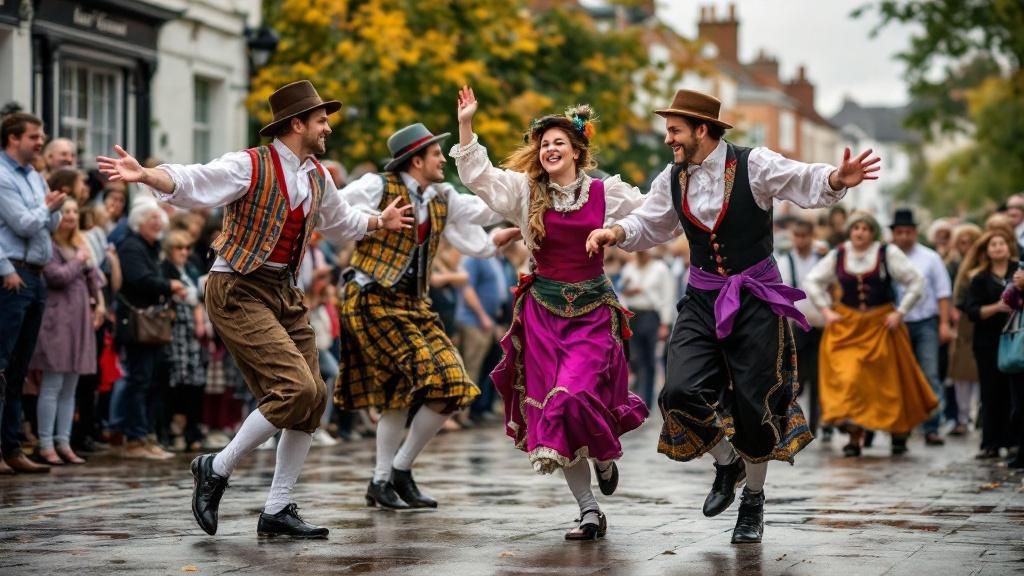
Once cast aside as a charming remnant of England’s countryside traditions, Morris dancing is undergoing an surprising resurgence amongst Britain’s younger generation. From academic organisations to country spaces, enthusiasts aged under thirty are reconnecting with the intricate steps, bell-adorned accessories, and bright garments that have characterised this long-established practice. This article explores the forces propelling this artistic renaissance, examines how modern dancers are reimagining the tradition, and explores what this revived engagement reveals about current British views towards heritage and community.
The Cultural Renaissance of Morris Dance
The return of Morris dancing amongst young people across Britain reflects a striking departure from years of falling participation. What was once viewed as an exclusively rural or elderly pursuit has become a lively cultural phenomenon, with student societies, urban dance groups, and community groups genuinely championing the tradition. This resurgence questions established stereotypes and demonstrates that contemporary youth truly recognise the worth of preserving and celebrating Britain’s traditional heritage, revitalising practices that appeared headed toward obscurity.
This revived interest goes further than simple nostalgic interest; younger dancers are actively reshaping Morris dancing for contemporary times. They blend modern music, experiment with inventive dance routines, and establish inclusive communities that accept people irrespective of background or prior experience. The movement reflects a wider cultural change wherein British youth increasingly seek authentic connections to their heritage whilst concurrently reconceiving the meaning of tradition, fostering a ongoing exchange between cultural accuracy and present-day creative forms that speaks to the values of their generation.
Why Younger Generations Are Adopting This Time-Honoured Craft
Morris dancing’s attraction for younger generations goes well past nostalgic curiosity. Contemporary dancers embrace the art form’s rich cultural heritage whilst valuing its ability to enable creative expression and social connection. The openness of modern Morris groups, paired with their inclusive ethos, has reshaped the perception of this conventionally closed-off pursuit. Young people are finding that Morris dancing delivers a meaningful alternative to standard recreational pursuits, affording both bodily exertion and genuine community engagement in an progressively computerised world.
Community and Belonging
In an era characterised by social fragmentation, Morris dancing groups provide young people with tangible communities founded on shared values and collaborative practice. The welcoming character of modern Morris organisations readily embraces newcomers irrespective of background or experience, nurturing genuine friendships and meaningful connections. Participants frequently characterise their dancing cohorts as chosen families, providing emotional support and belonging that extends well beyond the dancing calendar. This communal feeling becomes especially important for young people navigating the shift from education to work.
The cooperative design of Morris dancing inherently fosters group unity and shared accountability. Each dancer’s input directly influences the group’s aesthetic coordination and beat exactness, creating mutual reliance that reinforces social bonds. Many young dancers report that their Morris groups facilitate authentic connections in ways that standard social spaces regularly fail to achieve. The joint investment to sustaining and advancing this established custom creates a compelling awareness of common goal amongst participants.
Bodily Activity and Health and Wellness
Morris dancing demands substantial bodily effort, combining cardiovascular exercise with complex coordination and strength development. Young dancers gain enhanced physical capability whilst engaging in activity that carries cultural significance rather than merely utilitarian. The rhythmic, repetitive nature of Morris footwork offers contemplative benefits alongside bodily fitness, contributing positively to mental wellbeing. Participants commonly mention the comprehensive wellness advantages as a primary motivation for sustained involvement in their local Morris groups.
Beyond heart health advantages, Morris dancing cultivates body awareness and spatial perception and bodily confidence, especially beneficial for adolescents struggling with body image concerns. The focus on technical precision and group coordination redirects focus from appearance-based anxiety toward capability and achievement. Furthermore, the open-air staging tradition connected to Morris dancing prompts people to interact with natural environments and seasonal rhythms, promoting mental health through connection with the natural world and cultural heritage.
Regional Differences and Contemporary Modifications
Morris dancing practices vary significantly across Britain’s regions, with each region developing unique approaches capturing local heritage and landscape. The Cotswolds uphold the vigorous, athletic “Cotswold” approach, whilst the North West champions the highly detailed “Northwest” practice displaying ornate attire and detailed arrangements. Emerging performers are eagerly taking up these area-specific traditions, engaging in instruction and celebrations to master authentic techniques whilst recognising the subtle cultural elements woven throughout each tradition. This spatial range gives contemporary performers with diverse opportunities into Morris dancing, helping them relate to heritage rooted in their local areas.
Modern adaptations are concurrently expanding Morris dancing’s reach outside traditional contexts. Younger practitioners integrate contemporary music, experimental choreography, and inclusive casting practices, challenging historical gender and age restrictions. Mixed-gender sides and LGBTQ+ Morris groups have developed, fundamentally reshaping the tradition’s social dynamics. These innovations preserve the essential character—rhythmic footwork, bells, and festive energy—whilst making the practice more accessible and relevant to twenty-first-century participants. Such creative reinterpretation illustrates that heritage traditions needn’t remain static, successfully bridging historical authenticity with modern sensibilities.
The Future of Morris Dancing in the United Kingdom
As Morris dancing continues to captivate younger audiences, the tradition stands at a turning point. Contemporary dancers are consciously redefining the form whilst maintaining its cultural heritage, introducing fresh choreography and accessible methods that resonate with modern sensibilities. Universities report record membership in Morris societies, whilst festivals welcome exceptional participation of young participants. This momentum suggests the art form is moving beyond nostalgic curiosity to genuine cultural movement, building lasting structures for sustained development and lasting significance within British communities nationwide.
Looking ahead, Morris dancing’s trajectory appears notably encouraging. The convergence of social media promotion, straightforward instruction approaches, and younger generations’ desire for authentic social cohesion creates optimal environments for flourishing. Organisations are investing in mentorship programmes and regional competitions, developing talent pathways and facilitating knowledge sharing between experienced and novice dancers. Should this enthusiasm continue, Morris dancing may finally escape its reputation as exclusively tradition-centred, instead becoming acknowledged as a lively, changing tradition that genuinely improves contemporary British society and reinforces community ties across generations.
